• Home
  • Artist
  • Writer/Storyteller
  • Actress
  • Blog

Mary Lou Bagley

Call: 603.969.1848

  • facebook
  • goodreads
  • instagram
  • linked in

July 11, 2013 By Mary Lou Bagley Leave a Comment

Look Around You

imagery matters
imagery matters

First, let me repeat my writer’s mantra:  seat of the pants to the seat of the chair.  Next, let me ask a few questions …

When your seat is on the seat and you look around, what do you see?  When your seat is on the seat and you don’t look around, what is in your periphery?  When your seat is on the seat and you’re ready to write, what is the nature of the imagery surrounding you?

It is said that the unconscious mind takes in whatever the eye passes over, even lightly.  If that’s true, why not make the most of it?  Why not surround yourself with images conducive to creative output and supportive of your writing life?

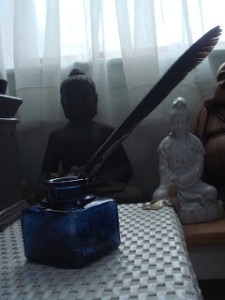
Ask yourself, as you place your seat upon the seat: What books are within reach?  What writing masters sit upon your shelf?   What paintings/posters/sketches hang upon your walls?  What messages, notes, or quotes are on display?  Whose framed faces look out at you?   What aromas, colors, and sounds infuse your senses? What symbolic icons create a sense of sacred space (whatever that may mean to you)?

Do you thrive when surrounded by deliciously haphazard piles of papers and books?  Are you most at ease with clean, clear surfaces all about you?  Does music aide you as you work?  Does silence serve you best?

I offer these questions as gentle nudgings, dear writer.

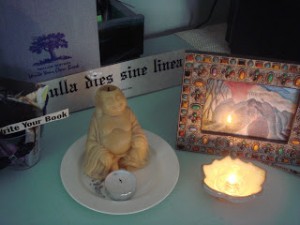
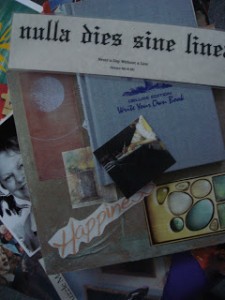
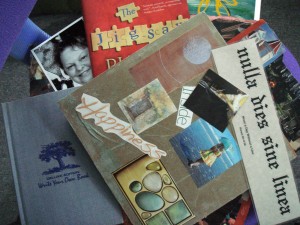
As for me?  My daughter’s dazzling smile and grandson’s smirking face greet me when I sit.  Anne Lamott, Natalie Goldberg, Julia Cameron, and Becky Rule are just a few of my chosen companions.  Sue Monk Kidd’s insights inspire me.  Don Murray’s laminated Latin phrase, “nulla dies sine linea,” (never a day without a line) is propped against an empty binding labeled, “Write Your Own Book.”  A sketch of a tree stump that drinks in poetry and spouts stories from its heart-shaped mouth, drawn while I was on retreat with Peter London, is tacked to the side of a filing cabinet nearby. A Sally Allen painting hangs above a simple shelf with artifacts and talismans steeped in meaning. A collage of buried treasures leans against the seafoam colored wall.  And, a simple tea light in a little dish waits to be lit when I’m ready.

Here I’ve surrounded myself in imagery that feeds my process (and encourages long visits from my muse).  Here I sit.  Here I write.

How about you?  Is it time, perhaps, to take a look around?  Is it time to create a space with conscious intent?  Is it time to make some changes to the one you already have?

Is it time to sit?  Is it time to write?

a simple sketch with meaning for my writer self


the tree from whence it came

Filed Under: Time To Write

May 13, 2013 By Mary Lou Bagley Leave a Comment

A moment, and then, … right back at it!

compbook

I opened an email a couple of weeks ago and yelped.  Yes.  I literally yelped.  I was alone.  No one was at home to share in my excitement.  But that was all right.

I yelped again just because yelping felt so darned good.  By sending out happy molecules into the atmosphere, I figure I was spreading joy.  Sharing the good is always a good thing.  Right?

That’s why I’m writing this blog post. This is not about bragging, this blogging.  It’s about sharing.  It’s about saying, “Hey, I’ve just had one of those moments we all get to have from time to time and I’m dancing in gratitude.  Come dance with me.”  It’s about being in community. It’s about my belief that if the arts are alive and well anywhere, they’re alive and well everywhere. It’s about knowing that my moment doesn’t stand as an either/or against your moment.  We all get to have them.  We all get to yelp.  We all get to dance.  Sometimes all at the same time!

As for my email, it began: “We are writing to tell you that your story, ‘Knowing When,’ has been selected …”

Yelp! …  Pause. … Yelp!

After spending hours and hours alone at my desk, there’s going to be publication and then there’s going to be …  a party!  Let’s hear it for the letter P: pleasure, publication and party. What solitary writer wouldn’t yelp?

Publication doesn’t define me as a writer, of course.  It’s not the end-all and be-all of the writing process.  The writing process is the end-all and the be-all of the writing process.  Process is the essence of the writing life. Finding your way into print – that’s a lovely plus.

I look forward to the fall publication of the book, Summer Stories, a collection inspired by the paintings of Leslie Anderson.  I am grateful for the opportunity offered by the collaboration between Maine Writers and Publishers Alliance and Shanti Arts Publishing.  I am grateful to Ron Currie, Jr. for selecting my story.  And I am grateful that I get to live the writing life.

Fall will come soon enough and I intend to be in every moment of that experience — publishing and partying and all.  In the meantime, as the echoes of my yelp fade, I’m back at my desk.  My novel’s main character, Margaret Meader, is telling her story and I’m taking it all down. Maybe one day there’ll be a release party for the publication of Otherwise, a novel by Mary Lou Hamilton Bagley.  But first, I have to put my seat to the seat and get it all down.

That’s what I do. I write.

Filed Under: Time To Write

May 12, 2013 By Mary Lou Bagley Leave a Comment

Haiku & Haibun: a practice, … explore with me

DSC07377

 A while ago, I began writing a daily haiku as a form of meditative practice.  Then, as often happens when we say we’re ready and open to something new, all sorts of doors began to open for me in connection to this art form.  I began to see how much I didn’t know about it and how much I wanted to explore and further develop my practice of it.

Most everyone has heard of these little poems that can be spoken in a breath.  Many of us have even written one or two in school using the traditional Japanese model.  That is: three lines with 5, 7, and 5 syllables per line. We learned that they are usually nature themed and often contain a season or nature word or phrase, though we may not have learned that this is known as a kigo.  

   What I came to realize only recently, is that American haiku don’t stick to the 5, 7, 5 format. They are usually three lines long, and are made up of approximately 17 syllables (sounds),but they are freer in style.  I must admit that finding out that American haiku purposely depart from the syllable count surprised this former English teacher of a certain age.  And to that I say, open me up and teach me more!

In April, I heard about a workshop with teacher and poet, Mimi White, on the haibun, a form related to haiku.  On a lark, I went.  (I am a strong believer in the benefits of traveling by lark!)  I was totally enchanted by Mimi’s teaching style and by this art form. Mimi explained and demonstrated that a haibun is a combination of short narrative prose paragraphs (poetic in nature) and haiku. They are used to recount travels or journeys, every day experiences, or special moments in life.  Mimi’s book, listed below, is about the time leading up to her father’s death and is hauntingly beautiful.  She invited us, near the end of the workshop, to write one or our own. In a very short time and with very few words, I explored my experience of the particularly long and deep winter that had just passed.  It felt comfortable to me.  Thus, I wrote my first haibun:

Spring is finally calling me back outside. Too long I’ve sat. Too long I’ve settled. Too long I’ve lingered on the too soft sofa looking out into the too white world. Waiting. Wanting. Willing the whiteness to take its leave!

toward the chuckling brook
I’m walking on tree shadows
mingling with the melt

Serendipitously, while at the workshop, I was invited by a friend to accompany her and Mimi to a day retreat at Rolling Ridge in North Andover, MA, called, “The Art of Awareness:  Haiku Now.”  I signed on.  Another lark ride.  (Did you know that a group of larks lifting off together in song is “an exaltation of larks?”  I just love that.)

Haiku offer far more than their brevity might suggest. They embody the essence of simplicity.  They capture a moment in concrete detail. They speak to us on many levels.  They keep us grounded in the present moment.  They get us to pause and observe.

As Jeanne F. Martin, the day’s workshop leader, says, “The best way to write a haiku is to remember what we were taught as children:  Stop. Look. Listen.” Writing one is truly an exercise in presence and awareness.  According to Martin, the great Japanese Haiku master, Basho, said, “In haiku there is nothing between you and the present moment.” He also said,  “You learn about the pine from the pine.”

As part of our group experience, Martin set out sprigs of herbs and other aromatic items and invited us to write.  For me, this became:

a childhood romp
running my fingertips
through thyme

After lunch, we were sent outside to observe, be in nature, and meet the present moment.  We were asked “to learn from the pines,” so to speak.   We were also asked to bring something back with us when done.   At the entrance of one of the two labyrinths there, I stood in the wind, experiencing my surroundings.  Out of this came the following haiku:

a sudden gust
a leaf aloft
a feather at my feet

I brought back the little feather and laid it on the cloth-covered table which had become a sort of altar with the other gatherings of the other poets.

I was reminded that day, that haiku rarely include metaphor or personification.  They are of the immediacy of the moment.  They need few, if any, adjectives or adverbs.  There is often a surprise or, in Jeanne Martin’s words, “a pop,” in the third line.  And that, in the words of Margaret McGee in A Sacred Art, “A haiku expresses the heart of a moment in three lines.”

Since these workshops, I’ve deepened my study of haiku by reading, writing, and immersing myself in “haiku mind.” As described by Patricia Donegan, “It is this way of being in the world with awakened open-hearted awareness — of being mindful of the ordinary moments of our lives — that I’ve come to call “haiku mind.” As I explore, I’m reminded again and again to pay attention and to pause and experience the sacred in the everyday, … the commonplace, … the smallest detail. I’m inspired, then, to write about it.  —  Every day, just three short lines that can be spoken in a breath.

Come and explore this with me, won’t you.  Write a haiku, write a haibun, read some of both.  And next, I’ll tell you about haiga!

* I have since joined the Haiku Society of America and look forward to receiving their journal, Frogpond.

Books on my table for further exploration:

Haiku Mind  —  108 Poems to Cultivate Awareness & Open Your Heart  
  ~ Patricia Donegan

The Haiku Handbook   How to Write, Teach, and Appreciate Haiku  
 ~ William Higginson and Penny Harter

Memory Won’t Save Me    a haibun
~Mimi White

Filed Under: Time To Write

  • « Previous Page
  • 1
  • …
  • 14
  • 15
  • 16
  • 17
  • 18
  • 19
  • Next Page »

Receive Latest Blog Posts!

* indicates required

Recent Posts

  • Meet Me at the Library
  • Reading at Eliot Maine’s William Fogg Library
  • MARGARET & I, READING at the BOOKTENDERS
  • And Now There Are 3 — books in the series, that is!
  • It’s Been a While …

Blog Archives

  • Home
  • Artist
  • Writer/Storyteller
  • Actress
  • Blog

© Copyright Mary Lou Bagley; All Rights Reserved :: Login